Wednesday, August 5, 2020

Minutes to Die, by Susan Sleeman

I always appreciate when a follow-up book exceeds its predecessor.  Minutes to Die is Susan Sleeman's second book in her "Homeland Heroes" series.  Minutes to Die is set shortly after Seconds to Live, but focuses on a difference set of main characters.  We see cameos from the characters from the first book, but Sleeman changes the focus to FBI Agent Kiley Dawson and ICE Agent Evan Bowers.  They are working together to prevent an attack on the anniversary of 9/11 that, their intel has said, will kill millions of Americans.

Kiley and Evan have some history they have to work through.  Evan is crazy about her, but Kiley has yet to forgive him for some of his past failures.  Reluctantly, she brings him into the investigation and they work closely throughout the book.  Over time, she grows to appreciate him and forgive him.  My main criticism of Seconds to Live was that he suspense portion of the book took a back seat to the romance.  In Minutes to Die, I was pleased to see that it was the opposite.  Yes, the budding romance is a theme throughout, but it is easily overshadowed by the investigation and tension building up to the anticipated attack.

This is an example that I just thought was funny.  Call me sexist, but I don't see scenes like this written in suspense novels written by a man.
He released her and stepped back.  "As much as I want to kiss you right now, I think it would be a good idea for us to put whatever this is going on between us on the back burner." . . . He knew she needed to succeed so she never had to live with the guilt of failing to stop the most deadly terrorist attack even perpetrated on American soil.
I know it sounds like I'm making fun.  Maybe I am, a little, cynical, un-romantic guy that I am, but seriously I was quite pleased that this passage was not typical of the book as a whole.  Minutes to Die is told in a straightforward way, focussing on Kiley's leadership and giving details of the investigation coming together with the team's various investigative skills and a little bit of luck.  It seems like Sleeman paid more attention to the technical, tactical, and logistical details of the investigation than she did in Seconds to Live--another plus.

Given the improvement of book 2 over book 1, I look forward to the anticipated book 3, to be released next year.  Romance or not, I am sure, like book 1 and 2, will be an enjoyable read. 


Thanks to NetGalley and the publisher for the complimentary electronic review copy!

Monday, August 3, 2020

Calling Bullshit, by Carl T. Bergstrom

Carl Bergstrom and Jevin West's Calling Bullshit: The Art of Skepticism in a Data-Driven World could not have come at a better time.  Well, maybe about three months ago would have been a better time.  The year 2020 has, so far, been primarily marked by Covid-19 and the response to it.  If you're like me, you are frustrated by the conflicting information given out by the media and the array of "experts."  Yes, a few of these folks have been studying contagious diseases for years, but then all these other "experts" chime in with their newly minted charts and graphs and "science" and "data" and we are left not knowing who to believe.  Politicians and the press say "listen to science" and "follow the data" then scientists disagree, data changes, and settled science suddenly becomes yesterday's news.

Bergsrtom and West, both professors at the University of Washington, bring some much-needed level headedness into the data-saturated, 24/7 news, social media world we live in.  (But due to the date of publication, Covid-19 is not part of this book.)  As they define it, b.s. (they use the word throughout, and call me prudish, it's just not a word in my vocabulary, so I'll use the short version in this review) "uses the language of math and science and statistics to create the impression of rigor and accuracy. . . .  New-school b.s. can be particularly effective because many of us don't feel qualified to challenge information that is presented in quantitative form."  A side comment about TED talks cracked me up.  So many people think a TED talk is the gold standard of authoritative, but they write "the TED brand of b.s. is just a cocktail of sound-bite science, management-speak, and techno-optimism."

We have access to more data than ever, but much of it is not reliable due to its source or presentation.  Bergstrom and West cover the various ways we are presented with b.s. and offer guidance to resist being taken in.  A favorite is numbers.  They "feel objective, but are easily manipulated to tell whatever story one desires."  Even better when data is presented in chart form.  Their section on charts and graphs may be the most useful part of the book.  They show the many ways an easy-to-read graph that seems to make a clear point may be concealing the very information you need.

In spite of their pretty clear lean to the left, they are balanced in their examples across the ideological spectrum.  Suffice it to say that no ideological group is exempt from the desire or habit of manipulating data and information to make a point.  Whether you are reading a Twitter post, watching the evening news, or even reading a paper in an academic journal, you will be better equipped to evaluate the information--and spotting b.s.--thanks to Bergstrom and West.  If someone starts a sentence with "studies say," "according to science," or something like that, put up your b.s. detector.


Thanks to NetGalley and the publisher for the complimentary electronic review copy!

Friday, July 31, 2020

Space Station Down, by Ben Bova and Doug Beason

Space Station Down, by Ben Bova and Doug Beason, starts off with a great premise: a cosmonaut and a space tourist arrive at the International Space Station and immediately start killing the crew.  They announce their intent to drop the ISS out of orbit, spew radioactive matter across the entire eastern part of the United States, and crash it into the heart of New York City, the impact of which will be far greater than an atomic bomb.

What they didn't count on was the presence of Kimberly Hasid-Robinson, the ISS chief who evades their initial attack and, as the sole surviving ISS crew member, has to figure out how to use her wits to foil their dastardly plan.  She is a brave, powerful, resourceful, and wily foe, who these criminals did not anticipate.

Besides the suspenseful standoff between Kimberly and the terrorists, which is most of the story, what I enjoyed most about Space Station Down was the realism.  Obviously, I have never been to the ISS.  Neither have Bova or Beason.  But they provide enough detail that I was fully convinced that the details about the ISS were accurate and realistic.  I feel confident that if I pulled up a schematic of ISS, it would reflect the descriptions in the story.

Space Station Down combines the things I enjoy about sci-fi: a near-future setting that utilizes current technology (with perhaps some speculation about next level tech), convincingly realistic depictions of the science, strong story elements of suspense, tension, romance, human relationships, and characters I can relate to and root for or against.  I'm not saying I hate sci-fi with aliens, fanciful technology, or philosophical explorations, but Space Station Down pushed a lot of buttons for me.  I enjoyed it a lot.


Thanks to NetGalley and the publisher for the complimentary electronic review copy!

Wednesday, July 29, 2020

The Beautiful Community, by Irwyn L. Ince, Jr.

Pastor Irwyn Ince has broken ground in the Presbyterian Church in America, as the first African-American elected as moderator of the General Assembly.  In a mostly white denomination, he's leading the charge for diversity, as he has done in the Grace DC Presbyterian churches where he has served as a pastor.  In his book The Beautiful Community, he further casts the message: the body of Christ is a beautiful community that includes people of all races.  He writes that "the ministry of reconciliation demonstrated in the local church by the gathering of people from diverse backgrounds, cultures, and ethnicities is the natural outworking of a rich covenantal theological commitment."

The covenantal relationship we share among ourselves, as reflected in our covenantal relationship with God, should also reflect the "beautiful community" shared among the three persons of the Trinity.  "To refuse to pursue unity in diversity as a redeemed people is to fundamentally neglect what it means for us to be the image of God."

Of course, the point of writing this book is that the church does not reflect that unity in diversity.  To be fair, I think we (meaning the contemporary American church) try harder than Ince gives us credit for.  Ince's anecdotes aside, I think it would be rare for a person of any race to walk into any church in America and be excluded or shunned because of race.  The larger question is the assimilation and blending of culture that should happen.  We, as humans, hang on to our identities.  "Our Blackness, our whiteness, our Asian-ness, our Latino-ness still tends to be at the center of our identity even after faith in Jesus Christ."  And this is reflected in the styles of worship we enjoy.  Ince points out that as welcoming as white Christians may be to other races in our churches, they still worship, teach, and fellowship like white people, expecting other races to assimilate to their ways (which are not biblical but cultural).

While this is true of white Christians, as the majority culture in America, I would argue that it's true of virtually any culture.  My wife and I are white and one of our children is black.  When he was getting old enough to be aware of the world around him, we moved to a new city and hoped to find a diverse church.  What we found were culturally black churches, some with a few white people, and culturally white churches, some with a few minorities.  We chose a mostly white church with a few black families and a couple of families who had also adopted black children.

Can worship ever be separated from culture?  Likely not.  Can we learn to worship together in beautiful communities?  Absolutely.  "He enables us to love, hear, seek, understand, and pursue one another in our diversity."  This is a process of discipleship, and of giving up our preferences.  I don't know how much The Beautiful Community moves us toward that goal, which will likely never be achieved short of heaven, but it's certainly food for thought and a challenge to consider how much of our worship, and even our theology, is tied to our cultural and racial preferences, not to our shared, biblical faith.


Thanks to NetGalley and the publisher for the complimentary electronic review copy!
Monday, July 27, 2020

Offworld, by Robin Parrish

On the way back from Mars, Chris Burke and his crew were looking forward to a hero's welcome and some time to reconnect with their lives on Earth.  Alas, the first people to walk on Mars were greeted by--no one.  Not only were there no people, there were no animals.  It was as if every living thing had instantly disappeared. 

So begins Robin Parrish's sci-fi novel Offworld.  Of course, the intrepid explorers and scientists that they are, they set out on a cross-country trek from Florida to Houston, where satellite images show a bright beam of light that, they figure, must have something to do with the disappearance.  Along the way, it seems as if the world is conspiring against them.  Among other perils, they struggle to survive an unnaturally severe storm, and a building inexplicably collapses on them. 

Ultimately, they discover that the cause of the disappearance is, in fact, human activity, and the humans who caused it are highly motivated to keep the crew from discovering the source.  This is a page turner for sure, but Parrish goes a little over the top with the luck of the crew and falls a bit short in the scientific purpose and means of the disappearance.  I am a little curious how this book fits with the other two in his "Dangerous Times" series, but I'm not sure I like it enough to take time to read those, too.  As a stand-alone title, Offworld leaves some unanswered questions, however, for the most part, wraps it all up nicely in the end.

Offworld (Dangerous Times Collection Book #1) by [Robin Parrish]

Friday, July 24, 2020

Small Town, Big Miracle, by Bishop W.C. Martin

Several years ago, I heard Bishop W. C. Martin speak at a conference, where he talked about his little church adopting dozens of children out of foster care.  His story touched me, and I'm so glad to run across his book, Small Town, Big Miracle: How Love Came to the Least of These.  Bishop Martin is pastor of Bennett Chapel in the tiny community of Possum Trot, in southeast Texas.  He and his wife and his wife's sister became convicted that God was calling them to adopt.  Based on their example, as well as on his preaching regularly on adoption, many families in their church followed their lead.  The inspiration caught on and before long a couple dozen families had adopted over seventy children.

If this weren't inspiring enough, you have to get the full picture of this community.  This is a town with no paved road, one of the poorest areas in the country.  But these folks are full of love, with love to spare.  Martin doesn't sugar coat the process, revealing that they did have plenty of problems.  As a community they had decided to focus on hard-to-adopt kids, older kids that had been in multiple foster homes.  They came to Possum Trot with habits, behaviors, and issues.  In many cases they had suffered abuse, neglect, molestation, beatings, starvation, and torture.  Acclimating them into families of love and trust was a process.  But they never had to send kids back into the system.

Martin and his family and friends and congregation are not superheroes, even though they seem to be.  They are Christians who followed the call of Jesus on their lives and families to love orphans in need.  Martin does not hesitate to call out other Christians.  It doesn't matter if you have little money, have other kids already, have kids with special needs, have no kids or are an empty nester, there is no reason why you can't consider adoption for yourself and your family.  If other churches, who have more people and more material resources, would follow Martin's and Bennett Chapel's example, no child would be stuck in foster care.  What an inspiring and challenging and beautiful story.

Wednesday, July 22, 2020

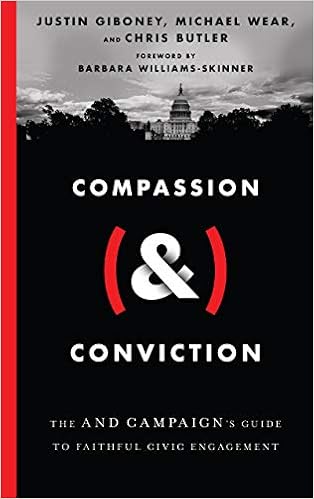
Compassion (&) Conviction, by Justin Giboney, Michael Wear, and Chris Butler

Justin Giboney, Micheal Wear, and Chris Butler are among the leaders of The AND Campaign, an organization dedicated to bringing together faith (&) politics, biblical values (&) social justice, truth (&) love.  (The ampersand in parentheses is their symbol.)  The three of them have put together some of their ideas about public life in Compassion (&) Conviction: The AND Campaign's Guide to Faithful Civic Engagement.  The goal of the book, and presumably the organization, is to develop "a gospel-centered framework to help Christians reflect the compassion and conviction of Jesus Christ in the public square." 

As they see it, one role of politics is to "provide[] a forum for advocating for our neighbor's well-being and pursuing justice," and that Christians "should participate in politics primarily to help others and to represent our Lord and Savior in the public square."  They advocate leaning on the teachings of scripture rather than conservative or progressive (or other) political ideology to dictate one's political and social perspective.  If a Christian finds himself always agreeing with one or the other political position, he is "intellectually lazy and easily manipulated" and "not being faithful." 

Christians in the public square should "be a source of moral clarity and biblical illumination in our world."  They might not always agree, but should set an example of civility: "Incivility among Christians in the public square is a genuine threat to the witness of the church."  We can disagree without "expressing contempt for one another."  

As unifying and non-partisan as Compassion (&) Conviction tries to be, the content of the book conveys a position that says, "True Christian faith will lean hard toward socially liberal political positions."  To the authors, public policy that favors minorities, immigrants, and the poor is the obvious and default position.  They never acknowledge that the Christian "preferential option for the poor" and the call to look out for one's neighbor, when enforced through legal structures, has the backing of the force of the state.  

When Christian virtue is enforced by the state, it is no longer virtue.  If I see my neighbor hungry, as a Christian I can and should seek to aid him.  But when I use the structure of the state to feed my hungry neighbor, I force one neighbor, with the threat of violence, to feed my other neighbor.  This fundamental truth about government throws cold water on the warm, fuzzy public ethic of these authors and others.  I agree that I am to love my neighbor, assist widows and orphans, etc., but when I try to enforce those obligations with the force of law rather than the calling of the heart, I am out of bounds and in violation of a free conscience.