It's no secret that pornography is more ubiquitous than ever. But it's also true that erotic art and writing have been around pretty much forever. So how did we get to where we are now, where porn is readily available anywhere there's an internet connection, and the industry generates billions in sales every year? Shira Tarrant explores the subject in The Pornography Industry: What Everyone Needs to Know.
First of all, given that The Pornography Industry is published by Oxford University Press, I expected a more scholarly approach. However, it's part of OUP's "What Everyone Needs to Know" series, which, now that I look at the titles, sounds like their version of ". . . For Dummies" books. Tarrant's topical chapters are laid out in a Q&A format, giving brief explanations and answers to a variety of questions. This makes it an easy reference source, but on controversial topics or topics which have divisive positions, just as Tarrant got started with presenting both sides, the section ended.
Although Tarrant skips over topics like a rock skipping across a pond, she at least deserves credit for bringing the reader's attention to some of these topics. Her subject is not frequently treated in an evenhanded manner. Most writing about pornography goes to one extreme or the other, defending it wholly, or calling for its prohibition. Suffice it to say that both sides are guilty of exaggeration to make their points, or glossing over facts that don't support their position.
Tarrant herself tends to gloss over the negatives of porn. She acknowledges that it can be harmful to relationships. She does not deny a link between sex trafficking and pornography. She notes the toll it can take on the performers, both physically and emotionally. Yet she tends toward a positive, nonjudgmental position in favor of porn. These negatives are part of the "porn wars," things we have to move past. She prefers a more positive view, and provides examples of companies and individuals who are working to make porn less sexist, less racist, and more fair trade (but no less porny).
The Pornography Industry would purport to be a scholarly approach to the history and impact of pornography on culture. It is that, but in a watered-down way. It's probably more than you really want to know about porn, but, at the same time, if you really want to know about porn, you will likely need to look elsewhere.
Thanks to NetGalley and the publisher for the complimentary electronic review copy!
Wednesday, March 30, 2016

Monday, March 28, 2016
Cold Barrel Zero, by Matthew Quirk
Who would want to read Cold Barrel Zero, by Matthew Quirk? Anyone who likes novels with lots of action, lots of technical descriptions of weaponry, medical details, and elaborate fighting and battle scenes. Cold Barrel Zero has all that and more.
Quirk loves plot twists, cliffhangers, and keeping the reader guessing about who's on whose side. One key character, Thomas Byrne, starts and finishes as the good guy. We know this because the portions of the novel that focus on Byrne are written in the first person from his perspective. There are some unquestionably bad guys, as well as some more ambiguous characters. Their portions are written in the third person. I don't want to make too much of the shifting perspectives and voices, but I wasn't that big a fan of the style.
Byrne, a veteran who is working as an ER doctor and trying to forget about the trauma behind him in his time of service, has the bad luck of being close by when some of his former buddies rob an armored truck. Byrne comes under suspicion and doesn't know whether to trust his buddies or the military officials who come after him. Quirk's plot is twisted, unpredictable, and, depending on your perspective may be either hard to follow or satisfyingly complex. Several points of resolution caught me by surprise!
I am reluctant to compare Quirk to other authors. There are definitely some with whom he shares the genre of military suspense fiction. But he has his own voice; you can read those comparisons elsewhere. Quirk's writing is fast-paced and realistic. He clearly gets a thrill out of keeping the reader in the dark and on the edge of his seat, making for a darkly entertaining read.
Thanks to NetGalley and the publisher for the complimentary electronic review copy!
Quirk loves plot twists, cliffhangers, and keeping the reader guessing about who's on whose side. One key character, Thomas Byrne, starts and finishes as the good guy. We know this because the portions of the novel that focus on Byrne are written in the first person from his perspective. There are some unquestionably bad guys, as well as some more ambiguous characters. Their portions are written in the third person. I don't want to make too much of the shifting perspectives and voices, but I wasn't that big a fan of the style.
Byrne, a veteran who is working as an ER doctor and trying to forget about the trauma behind him in his time of service, has the bad luck of being close by when some of his former buddies rob an armored truck. Byrne comes under suspicion and doesn't know whether to trust his buddies or the military officials who come after him. Quirk's plot is twisted, unpredictable, and, depending on your perspective may be either hard to follow or satisfyingly complex. Several points of resolution caught me by surprise!
I am reluctant to compare Quirk to other authors. There are definitely some with whom he shares the genre of military suspense fiction. But he has his own voice; you can read those comparisons elsewhere. Quirk's writing is fast-paced and realistic. He clearly gets a thrill out of keeping the reader in the dark and on the edge of his seat, making for a darkly entertaining read.
Thanks to NetGalley and the publisher for the complimentary electronic review copy!
Sunday, March 27, 2016
Surf NYC, by Andreea Waters
 Surfing in New York? Yes, why not! The culture and waves may be different from surfing in Southern California, but surfers surf, and some of them live in the Big Apple. Photographer Andreea Waters documents New York City surfing in her book Surf NYC.
Combining stunning photography and brief statements from New York surfers, Waters highlights the differences and similarities when comparing New York surfers and surfers from area more traditionally associated with surfing. Like surfers everywhere, NYC surfers have an almost religious dedication to the sport. (In some cases, there's nothing "almost" about it, like the surfer who mused, "Surfing is my religion, and the ocean is my temple.") In New York, though, given the unpredictability of conditions, the weather, and the logistics of getting to the beach, the dedication takes on another level of madness.
One huge factor in NYC surfing is the weather. Sometimes the best waves are in the winter. In the pictures the surfers are almost always seen in head-to-toe neoprene. This quote typifies the attitude of openness to whatever weather conditions come: "If you've ever dropped into a perfect wave, yet complained about the falling snow blurring your vision . . . then you know what it's like to surf in New York." A little snow? Big deal--if the waves are breaking, he's there!

Surfers everywhere will delight in Waters's pictures and descriptions of NYC surfing. I'm guess Rockaway Beach is not destined to become a mecca for surfers from around the world, but those NYC surfers who lug their boards on the subway in the middle of winter in hopes of catching some waves know there's something special in NYC.

Thanks to NetGalley and the publisher for the complimentary electronic review copy!
2016 Reading Challenge: A photo essay book
#vtReadingChallenge
Friday, March 25, 2016
Rogue Lawyer, by John Grisham
I have read almost everything Grisham has written, and I have to say I have enjoyed every book. Rogue Lawyer is no exception. Sebastian Rudd is a creep, and tends toward the dirty side of the law, but Grisham makes him likable and gives him street integrity that I could cheer for. He picks up cases no other lawyer wants, loves to get publicity, and doesn't mind defending despicable criminals.
Rogue Lawyer is less a complete novel than a snapshot of a few weeks in a rogue lawyer's life. The book covers several cases, some of which end up being loosely related. We see the courtroom drama and the back street deals that characterize Rudd's practice. We meet his awful ex-wife and their remarkably sweet son. We hear the ethical conundrums he gets himself into. We feel the punches of the cage fighter he sponsors and ends up defending.
I'm not a lawyer, so I can't judge by personal experience, but this novel feels more real and gritty than many of his other ones. The flip side of that is that it also feels more pedestrian. It lacks a single thread of a story to keep me on the edge of my seat. Furthermore, I felt like he left some loose ends unresolved. Nevertheless, I kept reading, and enjoyed it. I was just surprised. I don't recall another Grisham novel that reads like this, a case book or short story collection. Grisham is a talented enough writer to make it work, but I didn't like it as much as his other novels.
2016 Reading Challenge: A book on the current New York Times list of bestsellers
#vtReadingChallenge
Rogue Lawyer is less a complete novel than a snapshot of a few weeks in a rogue lawyer's life. The book covers several cases, some of which end up being loosely related. We see the courtroom drama and the back street deals that characterize Rudd's practice. We meet his awful ex-wife and their remarkably sweet son. We hear the ethical conundrums he gets himself into. We feel the punches of the cage fighter he sponsors and ends up defending.
I'm not a lawyer, so I can't judge by personal experience, but this novel feels more real and gritty than many of his other ones. The flip side of that is that it also feels more pedestrian. It lacks a single thread of a story to keep me on the edge of my seat. Furthermore, I felt like he left some loose ends unresolved. Nevertheless, I kept reading, and enjoyed it. I was just surprised. I don't recall another Grisham novel that reads like this, a case book or short story collection. Grisham is a talented enough writer to make it work, but I didn't like it as much as his other novels.
2016 Reading Challenge: A book on the current New York Times list of bestsellers
#vtReadingChallenge
Wednesday, March 23, 2016
Switched On, by John Elder Robison
As many people with autism, and their advocates, will tell you, although autism is considered a disability, it can also be considered a gift. David Burns affirmed in his recent book, Do Lemons Have Feathers? that he considers autism "a gift and advantage." So when people talk about a cure for autism, it seems misguided, perhaps even offensive.
John Elder Robison was not seeking a cure for his autism, but when he was asked to participate in a study treating autism with transcranial magnetic stimulation (TMS), he jumped in. I had read Robison's book Raising Cubby, about his and his son's lives with Asperger's, so I was familiar with Robison's brilliance and giftedness in music production, auto repair, and other fields. Robison was particularly interested on the impact TMS might have on a trait he shares with many autistic individuals, social awkwardness.
Robison is not a doctor or neuroscientist, so Switched On: A Memoir of Brain Change and Social Awakening should not be taken as medically prescriptive. Rather, it's Robison's story of how having directed electrical impulses shot into his brain (to put it crudely) affected his very personality. TMS is being used to treat people with depression; the treatment of people with autism is expanding, but is still experimental.
The results, for Robison, were astounding. He gained levels of emotional awareness and connection with other people that he had never before experienced. He also experienced music and color in a way that had escaped him. Some of the effects, like the connections to music, ended up being temporary. But the changes in his personality, in terms of interacting with people, having empathy for others, and reading emotions, expressions, and body language, stuck. He concludes that he's "gone from being a machine person who interfaced with humans when he had to to a people person who understands technology."
As enthusiastic as he is for the promise of TMS for the treatment of autism, he acknowledges that there are dangers. In his case, it led to his divorce. On another level, he wonders if, had he been treated with TMS as a child, would he have been more social, thus stifling his interest in machines and music. While TMS might help autistic people become more successful in relationships with others, could it cost them other traits, or cause them not to develop other gifts? In telling his story, Robison raises these questions, while offering his perspective and experiences as a guide.
Robison is a pleasure to read. His quirkiness comes through, yet he communicates so well what the experience of living with autism is like. If for nothing else, autistic individuals and their friends and family will want to read Switched On and Robison's other books for his unique perspective. But at a greater level, they will want to read Switched On for a glimpse of TMS and what it may promise. As Robison writes, "We are truly on the brink of a new era for treatment of the mind."
Thanks to NetGalley and the publisher for the complimentary electronic review copy!
2016 Reading Challenge: A memoir
#vtReadingChallenge
John Elder Robison was not seeking a cure for his autism, but when he was asked to participate in a study treating autism with transcranial magnetic stimulation (TMS), he jumped in. I had read Robison's book Raising Cubby, about his and his son's lives with Asperger's, so I was familiar with Robison's brilliance and giftedness in music production, auto repair, and other fields. Robison was particularly interested on the impact TMS might have on a trait he shares with many autistic individuals, social awkwardness.
Robison is not a doctor or neuroscientist, so Switched On: A Memoir of Brain Change and Social Awakening should not be taken as medically prescriptive. Rather, it's Robison's story of how having directed electrical impulses shot into his brain (to put it crudely) affected his very personality. TMS is being used to treat people with depression; the treatment of people with autism is expanding, but is still experimental.
The results, for Robison, were astounding. He gained levels of emotional awareness and connection with other people that he had never before experienced. He also experienced music and color in a way that had escaped him. Some of the effects, like the connections to music, ended up being temporary. But the changes in his personality, in terms of interacting with people, having empathy for others, and reading emotions, expressions, and body language, stuck. He concludes that he's "gone from being a machine person who interfaced with humans when he had to to a people person who understands technology."
As enthusiastic as he is for the promise of TMS for the treatment of autism, he acknowledges that there are dangers. In his case, it led to his divorce. On another level, he wonders if, had he been treated with TMS as a child, would he have been more social, thus stifling his interest in machines and music. While TMS might help autistic people become more successful in relationships with others, could it cost them other traits, or cause them not to develop other gifts? In telling his story, Robison raises these questions, while offering his perspective and experiences as a guide.
Robison is a pleasure to read. His quirkiness comes through, yet he communicates so well what the experience of living with autism is like. If for nothing else, autistic individuals and their friends and family will want to read Switched On and Robison's other books for his unique perspective. But at a greater level, they will want to read Switched On for a glimpse of TMS and what it may promise. As Robison writes, "We are truly on the brink of a new era for treatment of the mind."
Thanks to NetGalley and the publisher for the complimentary electronic review copy!
2016 Reading Challenge: A memoir
#vtReadingChallenge
Monday, March 21, 2016
Fool Me Once, by Harlan Coben
Harlan Coben has sold a ton of books. His newest, Fool Me Once, captures all the elements that have made him popular: relatable, realistic characters, lots of twists and turns, and a story that could happen in today's headlines, or maybe in your own neighborhood or family.
Poor Maya Burkett lost her husband in a mugging in Central Park. On top of that, she's dealing with the aftermath of a botched military mission; she struggles to sleep, fighting the flashbacks. Maya is adjusting to life as a single mom, and, at the urging of her friend, sets up a nanny cam. Her world is rocked when she sees, or seems to see, her late husband show up to play with their daughter, caught on film by the nanny cam.
Is she going crazy? Is her husband alive? Are her wealthy in-laws keeping something from her? What about the car that's been following her? And her sister's mysterious murder? Does death simply follow her, or are there bigger questions here? Maya sets out to unravel these mysteries on her own. She will, of course, get to the bottom of it, but not in a way that I would have expected.
I enjoyed reading Maya's quest for truth and resolution. Coben's plot verged over to the edge of the ridiculous at times, but never went over the edge. Fool Me Once kept me guessing, just about to the climax, and Coben ties the various strings of questions together nicely at the end. I have little doubt that this will be another best seller for Coben, and that his fans and new readers alike will not be disappointed.
Thanks to NetGalley and the publisher for the complimentary electronic review copy!
2016 Reading Challenge: A mystery or detective novel
#vtReadingChallenge
Poor Maya Burkett lost her husband in a mugging in Central Park. On top of that, she's dealing with the aftermath of a botched military mission; she struggles to sleep, fighting the flashbacks. Maya is adjusting to life as a single mom, and, at the urging of her friend, sets up a nanny cam. Her world is rocked when she sees, or seems to see, her late husband show up to play with their daughter, caught on film by the nanny cam.
Is she going crazy? Is her husband alive? Are her wealthy in-laws keeping something from her? What about the car that's been following her? And her sister's mysterious murder? Does death simply follow her, or are there bigger questions here? Maya sets out to unravel these mysteries on her own. She will, of course, get to the bottom of it, but not in a way that I would have expected.
I enjoyed reading Maya's quest for truth and resolution. Coben's plot verged over to the edge of the ridiculous at times, but never went over the edge. Fool Me Once kept me guessing, just about to the climax, and Coben ties the various strings of questions together nicely at the end. I have little doubt that this will be another best seller for Coben, and that his fans and new readers alike will not be disappointed.
Thanks to NetGalley and the publisher for the complimentary electronic review copy!
2016 Reading Challenge: A mystery or detective novel
#vtReadingChallenge
Sunday, March 20, 2016
Through the Habitrails, by Jeff Nicholson
Jeff Nicholson says Through the Habitrails: Life Before and After My Career in the Cubicles really isn't autobiographical. All the better for him. His graphic novel, published serially and intermittently through the 1990s, presents a creepy, bleak, and dehumanizing picture of corporate life.
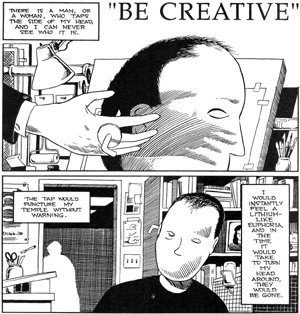 Our protagonist slaves in his cubicle creating content, while the gerbils, who somehow run the place, run around in their habitrails. People sneak up behind him and slap on tap on his head to sap his creative juices. In one of the more depressing-sounding expressions of an attitude shared by employees everywhere, Nicholson writes: "The company won two-thirds of my life, and drained the juices from my driven flesh for its own needless product."
This sense of alienation from work, or rather from the fruits of one's labor, permeates Through the Habitrails. Nicholson's office worker labors on, yet seeks means of escape, both literal and through food, entertainment, drugs, and drink. The last is most memorable, in the form of a jar he encases his entire head in a keeps filled with beer. Yes, it's as weird as it sounds.
This new re-issue includes an introduction by Stephen Bissette, who published Through the Habitrails in Taboo magazine, a comics anthology that specialized in horror and other edgy comics. He rightly points out that Nicholson's work is a sort of mix of Kafka and Dilbert, although it's much more subversive and disturbing than Dilbert. The tone is certainly Kafkaesque. (Bissette bemoans the fact that "Kafkaesque" is used by people who have never read Kafka or know who he is. But he never makes clear whether Nicholson himself read or was influenced by Kafka. I'm curious whether or not this is the case.)
I was struck with thought, where are the positive, affirming depictions of labor, of business, of making a living in a traditional job? Comics and other entertainment on this theme (think Office Space and The Office) draw on the perpetual, perceived struggle of labor versus management. I guess people who are not disgruntled don't write comics. It's just that many companies are great and make fantastic contributions to humanity. Many employees of big companies are content or even enthused about the role they play in something bigger than themselves. We simply don't see that state of things portrayed in comics, movies, or fiction very often.
Through the Habitrails is an entertaining collection of weirdness that is probably more relevant today than it was in the early 1990s, when it appeared in Taboo. Too bad Nicholson is not writing comics today.
Thanks to NetGalley and the publisher for the complimentary electronic review copy!
 Our protagonist slaves in his cubicle creating content, while the gerbils, who somehow run the place, run around in their habitrails. People sneak up behind him and slap on tap on his head to sap his creative juices. In one of the more depressing-sounding expressions of an attitude shared by employees everywhere, Nicholson writes: "The company won two-thirds of my life, and drained the juices from my driven flesh for its own needless product."
This sense of alienation from work, or rather from the fruits of one's labor, permeates Through the Habitrails. Nicholson's office worker labors on, yet seeks means of escape, both literal and through food, entertainment, drugs, and drink. The last is most memorable, in the form of a jar he encases his entire head in a keeps filled with beer. Yes, it's as weird as it sounds.
This new re-issue includes an introduction by Stephen Bissette, who published Through the Habitrails in Taboo magazine, a comics anthology that specialized in horror and other edgy comics. He rightly points out that Nicholson's work is a sort of mix of Kafka and Dilbert, although it's much more subversive and disturbing than Dilbert. The tone is certainly Kafkaesque. (Bissette bemoans the fact that "Kafkaesque" is used by people who have never read Kafka or know who he is. But he never makes clear whether Nicholson himself read or was influenced by Kafka. I'm curious whether or not this is the case.)
I was struck with thought, where are the positive, affirming depictions of labor, of business, of making a living in a traditional job? Comics and other entertainment on this theme (think Office Space and The Office) draw on the perpetual, perceived struggle of labor versus management. I guess people who are not disgruntled don't write comics. It's just that many companies are great and make fantastic contributions to humanity. Many employees of big companies are content or even enthused about the role they play in something bigger than themselves. We simply don't see that state of things portrayed in comics, movies, or fiction very often.
Through the Habitrails is an entertaining collection of weirdness that is probably more relevant today than it was in the early 1990s, when it appeared in Taboo. Too bad Nicholson is not writing comics today.
Thanks to NetGalley and the publisher for the complimentary electronic review copy!
Subscribe to:
Posts (Atom)