I have read almost everything Grisham has written, and I have to say I have enjoyed every book. Rogue Lawyer is no exception. Sebastian Rudd is a creep, and tends toward the dirty side of the law, but Grisham makes him likable and gives him street integrity that I could cheer for. He picks up cases no other lawyer wants, loves to get publicity, and doesn't mind defending despicable criminals.
Rogue Lawyer is less a complete novel than a snapshot of a few weeks in a rogue lawyer's life. The book covers several cases, some of which end up being loosely related. We see the courtroom drama and the back street deals that characterize Rudd's practice. We meet his awful ex-wife and their remarkably sweet son. We hear the ethical conundrums he gets himself into. We feel the punches of the cage fighter he sponsors and ends up defending.
I'm not a lawyer, so I can't judge by personal experience, but this novel feels more real and gritty than many of his other ones. The flip side of that is that it also feels more pedestrian. It lacks a single thread of a story to keep me on the edge of my seat. Furthermore, I felt like he left some loose ends unresolved. Nevertheless, I kept reading, and enjoyed it. I was just surprised. I don't recall another Grisham novel that reads like this, a case book or short story collection. Grisham is a talented enough writer to make it work, but I didn't like it as much as his other novels.
2016 Reading Challenge: A book on the current New York Times list of bestsellers
#vtReadingChallenge
Friday, March 25, 2016

Wednesday, March 23, 2016
Switched On, by John Elder Robison
As many people with autism, and their advocates, will tell you, although autism is considered a disability, it can also be considered a gift. David Burns affirmed in his recent book, Do Lemons Have Feathers? that he considers autism "a gift and advantage." So when people talk about a cure for autism, it seems misguided, perhaps even offensive.
John Elder Robison was not seeking a cure for his autism, but when he was asked to participate in a study treating autism with transcranial magnetic stimulation (TMS), he jumped in. I had read Robison's book Raising Cubby, about his and his son's lives with Asperger's, so I was familiar with Robison's brilliance and giftedness in music production, auto repair, and other fields. Robison was particularly interested on the impact TMS might have on a trait he shares with many autistic individuals, social awkwardness.
Robison is not a doctor or neuroscientist, so Switched On: A Memoir of Brain Change and Social Awakening should not be taken as medically prescriptive. Rather, it's Robison's story of how having directed electrical impulses shot into his brain (to put it crudely) affected his very personality. TMS is being used to treat people with depression; the treatment of people with autism is expanding, but is still experimental.
The results, for Robison, were astounding. He gained levels of emotional awareness and connection with other people that he had never before experienced. He also experienced music and color in a way that had escaped him. Some of the effects, like the connections to music, ended up being temporary. But the changes in his personality, in terms of interacting with people, having empathy for others, and reading emotions, expressions, and body language, stuck. He concludes that he's "gone from being a machine person who interfaced with humans when he had to to a people person who understands technology."
As enthusiastic as he is for the promise of TMS for the treatment of autism, he acknowledges that there are dangers. In his case, it led to his divorce. On another level, he wonders if, had he been treated with TMS as a child, would he have been more social, thus stifling his interest in machines and music. While TMS might help autistic people become more successful in relationships with others, could it cost them other traits, or cause them not to develop other gifts? In telling his story, Robison raises these questions, while offering his perspective and experiences as a guide.
Robison is a pleasure to read. His quirkiness comes through, yet he communicates so well what the experience of living with autism is like. If for nothing else, autistic individuals and their friends and family will want to read Switched On and Robison's other books for his unique perspective. But at a greater level, they will want to read Switched On for a glimpse of TMS and what it may promise. As Robison writes, "We are truly on the brink of a new era for treatment of the mind."
Thanks to NetGalley and the publisher for the complimentary electronic review copy!
2016 Reading Challenge: A memoir
#vtReadingChallenge
John Elder Robison was not seeking a cure for his autism, but when he was asked to participate in a study treating autism with transcranial magnetic stimulation (TMS), he jumped in. I had read Robison's book Raising Cubby, about his and his son's lives with Asperger's, so I was familiar with Robison's brilliance and giftedness in music production, auto repair, and other fields. Robison was particularly interested on the impact TMS might have on a trait he shares with many autistic individuals, social awkwardness.
Robison is not a doctor or neuroscientist, so Switched On: A Memoir of Brain Change and Social Awakening should not be taken as medically prescriptive. Rather, it's Robison's story of how having directed electrical impulses shot into his brain (to put it crudely) affected his very personality. TMS is being used to treat people with depression; the treatment of people with autism is expanding, but is still experimental.
The results, for Robison, were astounding. He gained levels of emotional awareness and connection with other people that he had never before experienced. He also experienced music and color in a way that had escaped him. Some of the effects, like the connections to music, ended up being temporary. But the changes in his personality, in terms of interacting with people, having empathy for others, and reading emotions, expressions, and body language, stuck. He concludes that he's "gone from being a machine person who interfaced with humans when he had to to a people person who understands technology."
As enthusiastic as he is for the promise of TMS for the treatment of autism, he acknowledges that there are dangers. In his case, it led to his divorce. On another level, he wonders if, had he been treated with TMS as a child, would he have been more social, thus stifling his interest in machines and music. While TMS might help autistic people become more successful in relationships with others, could it cost them other traits, or cause them not to develop other gifts? In telling his story, Robison raises these questions, while offering his perspective and experiences as a guide.
Robison is a pleasure to read. His quirkiness comes through, yet he communicates so well what the experience of living with autism is like. If for nothing else, autistic individuals and their friends and family will want to read Switched On and Robison's other books for his unique perspective. But at a greater level, they will want to read Switched On for a glimpse of TMS and what it may promise. As Robison writes, "We are truly on the brink of a new era for treatment of the mind."
Thanks to NetGalley and the publisher for the complimentary electronic review copy!
2016 Reading Challenge: A memoir
#vtReadingChallenge
Monday, March 21, 2016
Fool Me Once, by Harlan Coben
Harlan Coben has sold a ton of books. His newest, Fool Me Once, captures all the elements that have made him popular: relatable, realistic characters, lots of twists and turns, and a story that could happen in today's headlines, or maybe in your own neighborhood or family.
Poor Maya Burkett lost her husband in a mugging in Central Park. On top of that, she's dealing with the aftermath of a botched military mission; she struggles to sleep, fighting the flashbacks. Maya is adjusting to life as a single mom, and, at the urging of her friend, sets up a nanny cam. Her world is rocked when she sees, or seems to see, her late husband show up to play with their daughter, caught on film by the nanny cam.
Is she going crazy? Is her husband alive? Are her wealthy in-laws keeping something from her? What about the car that's been following her? And her sister's mysterious murder? Does death simply follow her, or are there bigger questions here? Maya sets out to unravel these mysteries on her own. She will, of course, get to the bottom of it, but not in a way that I would have expected.
I enjoyed reading Maya's quest for truth and resolution. Coben's plot verged over to the edge of the ridiculous at times, but never went over the edge. Fool Me Once kept me guessing, just about to the climax, and Coben ties the various strings of questions together nicely at the end. I have little doubt that this will be another best seller for Coben, and that his fans and new readers alike will not be disappointed.
Thanks to NetGalley and the publisher for the complimentary electronic review copy!
2016 Reading Challenge: A mystery or detective novel
#vtReadingChallenge
Poor Maya Burkett lost her husband in a mugging in Central Park. On top of that, she's dealing with the aftermath of a botched military mission; she struggles to sleep, fighting the flashbacks. Maya is adjusting to life as a single mom, and, at the urging of her friend, sets up a nanny cam. Her world is rocked when she sees, or seems to see, her late husband show up to play with their daughter, caught on film by the nanny cam.
Is she going crazy? Is her husband alive? Are her wealthy in-laws keeping something from her? What about the car that's been following her? And her sister's mysterious murder? Does death simply follow her, or are there bigger questions here? Maya sets out to unravel these mysteries on her own. She will, of course, get to the bottom of it, but not in a way that I would have expected.
I enjoyed reading Maya's quest for truth and resolution. Coben's plot verged over to the edge of the ridiculous at times, but never went over the edge. Fool Me Once kept me guessing, just about to the climax, and Coben ties the various strings of questions together nicely at the end. I have little doubt that this will be another best seller for Coben, and that his fans and new readers alike will not be disappointed.
Thanks to NetGalley and the publisher for the complimentary electronic review copy!
2016 Reading Challenge: A mystery or detective novel
#vtReadingChallenge
Sunday, March 20, 2016
Through the Habitrails, by Jeff Nicholson
Jeff Nicholson says Through the Habitrails: Life Before and After My Career in the Cubicles really isn't autobiographical. All the better for him. His graphic novel, published serially and intermittently through the 1990s, presents a creepy, bleak, and dehumanizing picture of corporate life.
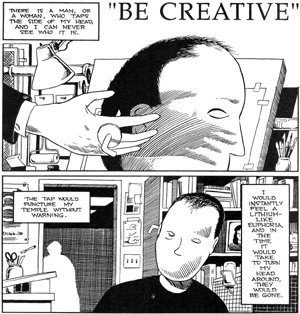 Our protagonist slaves in his cubicle creating content, while the gerbils, who somehow run the place, run around in their habitrails. People sneak up behind him and slap on tap on his head to sap his creative juices. In one of the more depressing-sounding expressions of an attitude shared by employees everywhere, Nicholson writes: "The company won two-thirds of my life, and drained the juices from my driven flesh for its own needless product."
This sense of alienation from work, or rather from the fruits of one's labor, permeates Through the Habitrails. Nicholson's office worker labors on, yet seeks means of escape, both literal and through food, entertainment, drugs, and drink. The last is most memorable, in the form of a jar he encases his entire head in a keeps filled with beer. Yes, it's as weird as it sounds.
This new re-issue includes an introduction by Stephen Bissette, who published Through the Habitrails in Taboo magazine, a comics anthology that specialized in horror and other edgy comics. He rightly points out that Nicholson's work is a sort of mix of Kafka and Dilbert, although it's much more subversive and disturbing than Dilbert. The tone is certainly Kafkaesque. (Bissette bemoans the fact that "Kafkaesque" is used by people who have never read Kafka or know who he is. But he never makes clear whether Nicholson himself read or was influenced by Kafka. I'm curious whether or not this is the case.)
I was struck with thought, where are the positive, affirming depictions of labor, of business, of making a living in a traditional job? Comics and other entertainment on this theme (think Office Space and The Office) draw on the perpetual, perceived struggle of labor versus management. I guess people who are not disgruntled don't write comics. It's just that many companies are great and make fantastic contributions to humanity. Many employees of big companies are content or even enthused about the role they play in something bigger than themselves. We simply don't see that state of things portrayed in comics, movies, or fiction very often.
Through the Habitrails is an entertaining collection of weirdness that is probably more relevant today than it was in the early 1990s, when it appeared in Taboo. Too bad Nicholson is not writing comics today.
Thanks to NetGalley and the publisher for the complimentary electronic review copy!
 Our protagonist slaves in his cubicle creating content, while the gerbils, who somehow run the place, run around in their habitrails. People sneak up behind him and slap on tap on his head to sap his creative juices. In one of the more depressing-sounding expressions of an attitude shared by employees everywhere, Nicholson writes: "The company won two-thirds of my life, and drained the juices from my driven flesh for its own needless product."
This sense of alienation from work, or rather from the fruits of one's labor, permeates Through the Habitrails. Nicholson's office worker labors on, yet seeks means of escape, both literal and through food, entertainment, drugs, and drink. The last is most memorable, in the form of a jar he encases his entire head in a keeps filled with beer. Yes, it's as weird as it sounds.
This new re-issue includes an introduction by Stephen Bissette, who published Through the Habitrails in Taboo magazine, a comics anthology that specialized in horror and other edgy comics. He rightly points out that Nicholson's work is a sort of mix of Kafka and Dilbert, although it's much more subversive and disturbing than Dilbert. The tone is certainly Kafkaesque. (Bissette bemoans the fact that "Kafkaesque" is used by people who have never read Kafka or know who he is. But he never makes clear whether Nicholson himself read or was influenced by Kafka. I'm curious whether or not this is the case.)
I was struck with thought, where are the positive, affirming depictions of labor, of business, of making a living in a traditional job? Comics and other entertainment on this theme (think Office Space and The Office) draw on the perpetual, perceived struggle of labor versus management. I guess people who are not disgruntled don't write comics. It's just that many companies are great and make fantastic contributions to humanity. Many employees of big companies are content or even enthused about the role they play in something bigger than themselves. We simply don't see that state of things portrayed in comics, movies, or fiction very often.
Through the Habitrails is an entertaining collection of weirdness that is probably more relevant today than it was in the early 1990s, when it appeared in Taboo. Too bad Nicholson is not writing comics today.
Thanks to NetGalley and the publisher for the complimentary electronic review copy!
Friday, March 18, 2016
Zero World, by Jason Hough
If you haven't read Jason Hough's Dire Earth cycle, you should. If you have, you will be delighted to hear that his new novel, Zero World, is just as good. Completely different, but just as good.
Assassin Peter Caswell has an implant that blocks all memories of his missions. An assassin who can't remember ever killing anyone? Interesting. His new mission sends him on a recovery mission in space. When they get to the abandoned ship, they find the crew all dead, except for one who is missing. Caswell's implant kicks in, marking the beginning of the period in which he won't be able to remember anything. He then kills the rest of his crew and takes a shuttle to pursue the one missing crew member.
To his great surprise, he finds himself on a world eerily similar to Earth, a parallel world with familiar geography and whose inhabitants speak a close proximation of English, yet with many odd differences. The technology of this world is a century or two behind Caswell's Earth, and he learns that the missing crew member has been introducing technology, making her powerful and rich in this new world.
Caswell's mission takes a twist when he and Melnie, an agent who has been spying on Caswell's target, end up as an unlikely team. Just when I thought I saw where the story was going, Hough inserts a twist that changed my perspective--and Caswell's mission--completely. Then that pesky mission-forgetting implant gets in the way at just the wrong time. . . .
Hough's writing is crisp, his pace is breakneck, and the alternative world building is captivating. His Dire Earth novels are epic in scope, with a huge cast of characters. Zero World focuses on Caswell, but the scope is still enormous. The implications of all that Caswell experiences open up a new future for humanity (and, hopefully, some sequels). If you like sci-fi with lots of action, lots of cool tech and lots of parallel world speculation, Zero World is sure to satisfy.
Thanks to NetGalley and the publisher for the complimentary electronic review copy!
Assassin Peter Caswell has an implant that blocks all memories of his missions. An assassin who can't remember ever killing anyone? Interesting. His new mission sends him on a recovery mission in space. When they get to the abandoned ship, they find the crew all dead, except for one who is missing. Caswell's implant kicks in, marking the beginning of the period in which he won't be able to remember anything. He then kills the rest of his crew and takes a shuttle to pursue the one missing crew member.
To his great surprise, he finds himself on a world eerily similar to Earth, a parallel world with familiar geography and whose inhabitants speak a close proximation of English, yet with many odd differences. The technology of this world is a century or two behind Caswell's Earth, and he learns that the missing crew member has been introducing technology, making her powerful and rich in this new world.
Caswell's mission takes a twist when he and Melnie, an agent who has been spying on Caswell's target, end up as an unlikely team. Just when I thought I saw where the story was going, Hough inserts a twist that changed my perspective--and Caswell's mission--completely. Then that pesky mission-forgetting implant gets in the way at just the wrong time. . . .
Hough's writing is crisp, his pace is breakneck, and the alternative world building is captivating. His Dire Earth novels are epic in scope, with a huge cast of characters. Zero World focuses on Caswell, but the scope is still enormous. The implications of all that Caswell experiences open up a new future for humanity (and, hopefully, some sequels). If you like sci-fi with lots of action, lots of cool tech and lots of parallel world speculation, Zero World is sure to satisfy.
Thanks to NetGalley and the publisher for the complimentary electronic review copy!
Wednesday, March 16, 2016
Moonlighting on the Internet, by Shelby Larson
Looking for a get-rich-quick scheme? Hoping for the magic bullet that will make you as rich as the infomercial stars who are selling magic bullets? Keep looking. That is not what you'll find in Shelby Larson's Moonlighting on the Internet: Make an Extra $1000 Per Month in Just 5-10 Hours Per Week. The subtitle is actually unfortunate. In my opinion, it makes the book sound like a scheme. But it's not.
Shelby Larson is an experienced entrepreneur who has updated Yanik Silver's 2008 book of the same name (with his blessing). She covers several business lines, what she calls "Profit Paths." Step one is to decide what Profit Path is best for you. Most of these businesses assume a fair amount of pre-acquired skills or talents: writing skills, technical knowledge and skills, artistic/graphic skills, business acumen, etc. Thus, much of her discussion is about marketing and using the internet to find and develop opportunities. Some Profit Paths are much less skill-oriented, so the marketing and internet knowledge is key.
At times, I thought she was pretty cavalier about what it takes to do well in these businesses. Her primary internet business has been freelance writing. I would guess the majority of readers would not be candidates for this; writing well is a rare and specific skill. Further, she talks about publishing ebooks on Amazon. I have known some authors, and success in publishing is about much more than setting up an Amazon acct. (Although she acknowledges that the best book ever written will never be read if no one knows about it!)
All in all, this is a great resource for people who are interested in having a go at an internet-based business. She is realistic and motivational, and provides a lot, I mean a lot, of internet resources in each chapter. Don't be deceived by the possibly click-bait-ey sounding subtitle. Moonlighting on the Internet is a serious resource for entrepreneurs serious about making some (potentially) serious money online.
http://www.moonlightingontheinternet.com/
Thanks to NetGalley and the publisher for the complimentary electronic review copy!
2016 Reading Challenge: A book about business
#vtReadingChallenge
Shelby Larson is an experienced entrepreneur who has updated Yanik Silver's 2008 book of the same name (with his blessing). She covers several business lines, what she calls "Profit Paths." Step one is to decide what Profit Path is best for you. Most of these businesses assume a fair amount of pre-acquired skills or talents: writing skills, technical knowledge and skills, artistic/graphic skills, business acumen, etc. Thus, much of her discussion is about marketing and using the internet to find and develop opportunities. Some Profit Paths are much less skill-oriented, so the marketing and internet knowledge is key.
At times, I thought she was pretty cavalier about what it takes to do well in these businesses. Her primary internet business has been freelance writing. I would guess the majority of readers would not be candidates for this; writing well is a rare and specific skill. Further, she talks about publishing ebooks on Amazon. I have known some authors, and success in publishing is about much more than setting up an Amazon acct. (Although she acknowledges that the best book ever written will never be read if no one knows about it!)
All in all, this is a great resource for people who are interested in having a go at an internet-based business. She is realistic and motivational, and provides a lot, I mean a lot, of internet resources in each chapter. Don't be deceived by the possibly click-bait-ey sounding subtitle. Moonlighting on the Internet is a serious resource for entrepreneurs serious about making some (potentially) serious money online.
http://www.moonlightingontheinternet.com/
Thanks to NetGalley and the publisher for the complimentary electronic review copy!
2016 Reading Challenge: A book about business
#vtReadingChallenge
Monday, March 14, 2016
Faith in the Voting Booth, by Leith Anderson and Galen Carey
Have you ever seen the "Christian voters guides"? Usually it's laid out in chart form, comparing candidates' stances on a variety of issues important to Christians (at least it reflects the guide's publisher's perception of what Christians are supposed to care about). If you're looking for something like that, keep looking. This book isn't it. Leith Anderson, president of the National Association of Evangelicals, and Galen Carey, vice president, government relations, of the NAE, have written Faith in the Voting Booth: Practical Wisdom for Voting Well.
If you know anything about the NAE, or about evangelicals in general, you won't be surprised to hear that these guys are not left wingers. But if you make assumptions about what they, as evangelicals, have to say be voting and political issues, you may be a bit surprised.
Anderson and Carey start out with the basics. I mean really basic. How to vote, how to register, where to go to vote, etc. These chapters seemed almost childish, but the statistics tell us that among Western democracies, voter turnout in the U.S. is inexcusably low. So there are plenty of people for whom a remedial education on the voting process is necessary!
Most of the book is taken up with a variety of issues. The authors discuss each from a Christian, biblical perspective, not in a dogmatic way but in a way that encourages asking lots of questions and, especially, reading lots of scripture. They express their dismay that Christians, when surveyed, reveal that they get guidance on political issues from non-scriptural sources much more than from scripture.
Anderson and Carey make it clear that their faith is in God, first and foremost, and that service to Him takes precedent above all else, no matter the country or party in power. However, they display a high faith in government as well, specifically in the role government can and should play in our lives. There are passive roles: "it can establish laws and resources that contribute to healthy families and support strong marriages." And there are more active roles: "While charity is crucial, we also need the government to step in and fulfill its responsibility to care for the poor." They make good arguments on both counts, but won't make libertarian readers happy with their conclusions.
On winning and losing, Anderson and Carey are eminently practical. They don't come out and say it doesn't matter who wins an election; clearly it matters who is writing, enforcing, and interpreting our laws. But, they point out that "just as the promises of a candidate often remain unfulfilled, so too the doom and gloom predicted if the other side wins often does not materialize." Campaign rhetoric is only rhetoric, and governing is much more difficult than campaigning.
So what is a Christian to do? On the one hand, Anderson and Carey provide a nice package of questions to ask as we consider who we vote for. The problem is, there is no one who will have all the right answers. So we hold our noses and vote for the least bad candidate. (That's my view, not necessarily theirs.) More than that, we vote and participate in the political, electoral process as "an act of faithful stewardship of our citizenship." Further, in our care for our neighbors, for creation, and for our families, and in our civil discourse, we demonstrate the gospel of Christ in our lives, as we pray with Jesus, "your kingdom come, your will be done."
Thanks to NetGalley and the publisher for the complimentary electronic review copy!
If you know anything about the NAE, or about evangelicals in general, you won't be surprised to hear that these guys are not left wingers. But if you make assumptions about what they, as evangelicals, have to say be voting and political issues, you may be a bit surprised.
Anderson and Carey start out with the basics. I mean really basic. How to vote, how to register, where to go to vote, etc. These chapters seemed almost childish, but the statistics tell us that among Western democracies, voter turnout in the U.S. is inexcusably low. So there are plenty of people for whom a remedial education on the voting process is necessary!
Most of the book is taken up with a variety of issues. The authors discuss each from a Christian, biblical perspective, not in a dogmatic way but in a way that encourages asking lots of questions and, especially, reading lots of scripture. They express their dismay that Christians, when surveyed, reveal that they get guidance on political issues from non-scriptural sources much more than from scripture.
Anderson and Carey make it clear that their faith is in God, first and foremost, and that service to Him takes precedent above all else, no matter the country or party in power. However, they display a high faith in government as well, specifically in the role government can and should play in our lives. There are passive roles: "it can establish laws and resources that contribute to healthy families and support strong marriages." And there are more active roles: "While charity is crucial, we also need the government to step in and fulfill its responsibility to care for the poor." They make good arguments on both counts, but won't make libertarian readers happy with their conclusions.
On winning and losing, Anderson and Carey are eminently practical. They don't come out and say it doesn't matter who wins an election; clearly it matters who is writing, enforcing, and interpreting our laws. But, they point out that "just as the promises of a candidate often remain unfulfilled, so too the doom and gloom predicted if the other side wins often does not materialize." Campaign rhetoric is only rhetoric, and governing is much more difficult than campaigning.
So what is a Christian to do? On the one hand, Anderson and Carey provide a nice package of questions to ask as we consider who we vote for. The problem is, there is no one who will have all the right answers. So we hold our noses and vote for the least bad candidate. (That's my view, not necessarily theirs.) More than that, we vote and participate in the political, electoral process as "an act of faithful stewardship of our citizenship." Further, in our care for our neighbors, for creation, and for our families, and in our civil discourse, we demonstrate the gospel of Christ in our lives, as we pray with Jesus, "your kingdom come, your will be done."
Thanks to NetGalley and the publisher for the complimentary electronic review copy!
Subscribe to:
Posts (Atom)