God is alive. Life in his is full. Jürgen Moltmann is deep.
Moltmann's new book, The Living God and the Fulness of Life, straddles an awkward space between academic theology and devotional literature. During my reading, at times my Christian spirit was moved and inspired, at times my academic, philosophical mind was challenged. Sometimes both at once.
Long a fixture at the University of Tübingen, where he taught systematic theology from 1963 to 1994 (I think I had a couple of professors who studied under him, so I guess I've been indirectly influenced by Moltmann), Moltmann writes from a Reformed, evangelical perspective, but I have a hard time pinning him down within that tradition.
I'm no theological scholar, and certainly have not extensively studied Moltmann's full body of work, but I like the way he seems to challenge core theological positions without wandering into the woods of heterodoxy. For example, he challenges the idea of God's unchangeable, immovable nature. "It is impossible to consider God as being unchangeable and immovable without declaring God to be dead. But the living God is free to move and change." God can also suffer: "The living God cannot be a God unable to suffer, because God is not a God without relationships." This idea of God in relationship, in community, is central to Moltmann's understanding of the trinity. After some of his early writings, Moltmann was criticized as a non-trinitarian. His discussion of the trinity in The Living God is worth studying, and, I think keeps him well-placed in orthodox, trinitarian theology.
I must admit that I sometimes felt out of my league when reading The Living God, but I think that's a good thing. It's been too many years since I've read serious theology, too many years of reading popular pastors' sermon series turned into inspirational but light-weight books. My mind and my spirit need to be challenged by theologians like Moltmann. I'll close with an apt summary of Motlmann's theme. "The experience of God will become the experience of being loved and affirmed from all eternity. That is the fullness of life." Amen to that, brother Motlmann.
Thanks to NetGalley and the publisher for the complimentary electronic review copy!
Friday, November 13, 2015

Wednesday, November 11, 2015
The Fifth Man, by John Olson and Randall Ingermanson
In Oxygen, a crew of four American astronauts overcome peril and hardship to become the first to walk on Mars. In John Olson and Randall Ingermanson's sequel, The Fifth Man, the crew faces the complexities of life on Mars, made more difficult by sickness, one crew member's madness, and another inexplicable presence.
As they did in Oxygen, Olson and Ingermanson craft a scientifically and logistically plausible sci-fi novel, with more drama and romance than you'll find in most sci-fi stories. Take that as I stated it: it can be good or bad, depending on your taste. In my opinion, they overdo the melodrama and romance. The characters come off as emotionally immature; I wondered what they heck they were doing on a Mars mission. On the other hand, I've never met an astronaut; perhaps Olson and Ingermanson's characterizations were spot on. Astronauts are, after all, mere mortals, just like me. They can be just as subject to romantic feelings, paranoid delusions, and fits of rage or panic as anyone else.
More than the melodrama, I enjoyed the portrayal of the mission. Olson and Ingermanson do not downplay or overlook the perils of working on Mars. They write in such a way that I could be convinced that if a Mars mission left today, it might look like their Aries mission. I'm sure they take liberties--it's fiction, after all--but for a non-professional like me, The Fifth Man is an effective portrayal of what the first Mars mission might look like. As to the fifth man himself, well, not to give anything away, but they do find life on Mars. However, it's nothing like a fifth man. While the mystery of the fifth man is a part of the story, I didn't really picture it as the central part.
The Fifth Man is an enjoyable sci-fi novel, published by a Christian publisher. Other than a few explorations of faith by the characters and a possible implied theme, there's not much here to call it Christian. I don't mean that as a criticism at all; it's refreshing to read characters who actually have faith, and who, when in trouble don't use God's name in vain but actually pray for God's help! I just mention this for Christian readers as well as unbelieving readers: this is not a stereotypical "Billy Graham film" type of novel with a big conversion scene at the end. It's a legitimate, entertaining sci-fi novel in which some of the characters are Christians.
As a sequel to Oxygen, The Fifth Man could stand alone, but is better read after reading Oxygen. Both are fast-paced, fun to read, and leave me wondering, Why didn't they make this a trilogy? Surely there are more stories to tell from this crew.
As they did in Oxygen, Olson and Ingermanson craft a scientifically and logistically plausible sci-fi novel, with more drama and romance than you'll find in most sci-fi stories. Take that as I stated it: it can be good or bad, depending on your taste. In my opinion, they overdo the melodrama and romance. The characters come off as emotionally immature; I wondered what they heck they were doing on a Mars mission. On the other hand, I've never met an astronaut; perhaps Olson and Ingermanson's characterizations were spot on. Astronauts are, after all, mere mortals, just like me. They can be just as subject to romantic feelings, paranoid delusions, and fits of rage or panic as anyone else.
More than the melodrama, I enjoyed the portrayal of the mission. Olson and Ingermanson do not downplay or overlook the perils of working on Mars. They write in such a way that I could be convinced that if a Mars mission left today, it might look like their Aries mission. I'm sure they take liberties--it's fiction, after all--but for a non-professional like me, The Fifth Man is an effective portrayal of what the first Mars mission might look like. As to the fifth man himself, well, not to give anything away, but they do find life on Mars. However, it's nothing like a fifth man. While the mystery of the fifth man is a part of the story, I didn't really picture it as the central part.
The Fifth Man is an enjoyable sci-fi novel, published by a Christian publisher. Other than a few explorations of faith by the characters and a possible implied theme, there's not much here to call it Christian. I don't mean that as a criticism at all; it's refreshing to read characters who actually have faith, and who, when in trouble don't use God's name in vain but actually pray for God's help! I just mention this for Christian readers as well as unbelieving readers: this is not a stereotypical "Billy Graham film" type of novel with a big conversion scene at the end. It's a legitimate, entertaining sci-fi novel in which some of the characters are Christians.
As a sequel to Oxygen, The Fifth Man could stand alone, but is better read after reading Oxygen. Both are fast-paced, fun to read, and leave me wondering, Why didn't they make this a trilogy? Surely there are more stories to tell from this crew.
Monday, November 9, 2015
Transforming Homosexuality, by Denny Burk
An amazing revolution in society and the church has taken place over that last few decades. Homosexuality, including homosexual marriage, has been normalized and accepted to a degree no one could have anticipated a generation ago. The church, as a whole, has been slower to accept homosexuality as acceptable behavior than secular society, but condemnation of homosexuality as sin is becoming rarer.
Denny Burk takes Christian talk about homosexuality beyond behavioral and ethical questions. In Transforming Homosexuality: What the Bible Says about Sexual Orientation and Change, Burk argues that Christian teaching on homosexuality is too focused on behavior, and not focused enough on orientation. That homosexual behavior is sinful is a given for Burk. He points out that many churches that still agree that homosexual acts are sinful will grant that homosexual orientation is not, in itself, sinful, and that many who identify as gay choose to live celibate lives but are still homosexual.
Burk takes what I thought was a common, widely accepted view of temptation--that being tempted is not a sin, it's acting on the temptation that is a sin--and turns it around. He aims to "establish from Scripture that desires for a sinful act are sinful precisely because the desired act is sinful." He "carefully define[s] same-sex attraction and show[s] from the Bible why it is sinful." I agree with him that the goal of the Christian life is holiness, and that we all have a sin nature. I'll even buy his assertion that homosexuality is outside of God's design, celibate or not. But he seems to go way to far in naming temptation or desire itself as sin.
On the plus side, Burk's concern is for those who are tempted by homosexuality. Churches have approached homosexuality as an ethical question, not as much as a pastoral question. All Christians are called to pursue purity and holiness. All sins require repentance. And all of us can change: "The same power that Jesus had to be restore to life is the same power that Christians have for moral change." What a great reminder. It's a powerful truth in an otherwise unnecessarily broad understanding of sin.
Thanks to NetGalley and the publisher for the complimentary electronic review copy!
Denny Burk takes Christian talk about homosexuality beyond behavioral and ethical questions. In Transforming Homosexuality: What the Bible Says about Sexual Orientation and Change, Burk argues that Christian teaching on homosexuality is too focused on behavior, and not focused enough on orientation. That homosexual behavior is sinful is a given for Burk. He points out that many churches that still agree that homosexual acts are sinful will grant that homosexual orientation is not, in itself, sinful, and that many who identify as gay choose to live celibate lives but are still homosexual.
Burk takes what I thought was a common, widely accepted view of temptation--that being tempted is not a sin, it's acting on the temptation that is a sin--and turns it around. He aims to "establish from Scripture that desires for a sinful act are sinful precisely because the desired act is sinful." He "carefully define[s] same-sex attraction and show[s] from the Bible why it is sinful." I agree with him that the goal of the Christian life is holiness, and that we all have a sin nature. I'll even buy his assertion that homosexuality is outside of God's design, celibate or not. But he seems to go way to far in naming temptation or desire itself as sin.
On the plus side, Burk's concern is for those who are tempted by homosexuality. Churches have approached homosexuality as an ethical question, not as much as a pastoral question. All Christians are called to pursue purity and holiness. All sins require repentance. And all of us can change: "The same power that Jesus had to be restore to life is the same power that Christians have for moral change." What a great reminder. It's a powerful truth in an otherwise unnecessarily broad understanding of sin.
Thanks to NetGalley and the publisher for the complimentary electronic review copy!
Sunday, November 8, 2015
Santa, Is It Really You? by Marilyn Harkrider, illustrated by Hannah Newsome
Here's one Christmas tradition you may have wondered about. Most of us sat on Santa's knee at some point, telling him our Christmas wishes. But how did the practice of people dressed like Santa, greeting children at the mall or in department stores, come about? Marilyn Harkrider has an idea, and she writes all about it in Santa, Is It Really You?
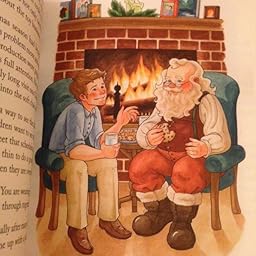 Years ago, Santa realized that he had become distant from his target audience. All his time was taken up with his Christmas duties that he never had an opportunity to actually spend time with the children. So he made it a practice, every Christmas Eve, to wake a child or two and visit.
He craved more time with the children, so at the suggestion of a helpful child, he started showing up at a department store, talking to the children there. That kept him too busy and away from his duties at the North Pole, so, at the suggestion of that same helpful child, he recruited substitute Santas, who would appear on his behalf and relay the messages from the children to the North Pole. To this day, those recruits work on his behalf. But you never know when he might make an appearance himself. . . .
Santa, Is It Really You? is a perfect story for those kids who are on the brink, trying to decide whether or not Santa is real. Harkrider has the answer to their questions about all the Santas they see during the Christmas season. Hannah Newsome's illustrations have a simple, classic look, sure to appeal to young readers and listeners. Harkrider's text is a bit wordy, which may put it out of reach for the toddler audience, but older preschoolers and younger elementary school children will delight in realizing the mystery of the multiple Santas around town at Christmas time.
Thanks to the publisher for the complimentary review copy!
Years ago, Santa realized that he had become distant from his target audience. All his time was taken up with his Christmas duties that he never had an opportunity to actually spend time with the children. So he made it a practice, every Christmas Eve, to wake a child or two and visit.He craved more time with the children, so at the suggestion of a helpful child, he started showing up at a department store, talking to the children there. That kept him too busy and away from his duties at the North Pole, so, at the suggestion of that same helpful child, he recruited substitute Santas, who would appear on his behalf and relay the messages from the children to the North Pole. To this day, those recruits work on his behalf. But you never know when he might make an appearance himself. . . .
Santa, Is It Really You? is a perfect story for those kids who are on the brink, trying to decide whether or not Santa is real. Harkrider has the answer to their questions about all the Santas they see during the Christmas season. Hannah Newsome's illustrations have a simple, classic look, sure to appeal to young readers and listeners. Harkrider's text is a bit wordy, which may put it out of reach for the toddler audience, but older preschoolers and younger elementary school children will delight in realizing the mystery of the multiple Santas around town at Christmas time.
Thanks to the publisher for the complimentary review copy!
Friday, November 6, 2015
Angel in Aisle 3, by Kevin West
If you're choosing a mentor, what sort of characteristics would you look for? How about someone professionally accomplished, a leader in his or her church and community, with a great marriage and terrific kids? Or how about someone who's all but homeless, poorly groomed, jobless, divorced, has little contact with his children, and doesn't smell good? Most of us would choose the former over the latter.
Kevin West probably would have chosen the same way, but when Don walked into his grocery store, everything changed. West had recently resigned from his position as a bank executive. He had participated in some illegal loan practices and was anticipating legal action against him, perhaps even prosecution and jail time. In the meantime, he spent his days running a small grocery store he had bought as an investment.
Don became a regular fixture at the store, and to Kevin's surprise, he looked forward to Don's visits. Not only did they become friends, Don became a spiritual mentor and life coach for Kevin. He had abundant wisdom as well as knowledge of the Bible, which he shared freely with Kevin and others.
Kevin West tells the story of his relationship with Don in Angel in Aisle 3: The True Story of a Mysterious Vagrant, a Convicted Bank Executive, and the Unlikely Friendship that Saved Both Their Lives. The subtitle says it all. These two men, whose lives up to the point of their meeting were so different, found common ground in their need for God and for each other's friendship. The writing's not the greatest. The recreated dialogue and flat story-telling style left a bit to be desired, but the genuineness of the story trumps any literary shortcomings.
Angel in Aisle 3 is a neat story of friendship. More importantly, it is a potent reminder to look past appearances and take time to get to know people. West might have looked at Don's unkempt appearance and closed himself off from a relationship with Don. Who in my life, in my city, could be a friend and mentor, but who is invisible to me now, or who I might avoid if our paths crossed? I pray the Lord will open my eyes, as he did for West and Don, to see the friends and mentors he has for me.
Thanks to Edelweiss and the publisher for the complimentary electronic review copy!
Kevin West probably would have chosen the same way, but when Don walked into his grocery store, everything changed. West had recently resigned from his position as a bank executive. He had participated in some illegal loan practices and was anticipating legal action against him, perhaps even prosecution and jail time. In the meantime, he spent his days running a small grocery store he had bought as an investment.
Don became a regular fixture at the store, and to Kevin's surprise, he looked forward to Don's visits. Not only did they become friends, Don became a spiritual mentor and life coach for Kevin. He had abundant wisdom as well as knowledge of the Bible, which he shared freely with Kevin and others.
Kevin West tells the story of his relationship with Don in Angel in Aisle 3: The True Story of a Mysterious Vagrant, a Convicted Bank Executive, and the Unlikely Friendship that Saved Both Their Lives. The subtitle says it all. These two men, whose lives up to the point of their meeting were so different, found common ground in their need for God and for each other's friendship. The writing's not the greatest. The recreated dialogue and flat story-telling style left a bit to be desired, but the genuineness of the story trumps any literary shortcomings.
Angel in Aisle 3 is a neat story of friendship. More importantly, it is a potent reminder to look past appearances and take time to get to know people. West might have looked at Don's unkempt appearance and closed himself off from a relationship with Don. Who in my life, in my city, could be a friend and mentor, but who is invisible to me now, or who I might avoid if our paths crossed? I pray the Lord will open my eyes, as he did for West and Don, to see the friends and mentors he has for me.
Thanks to Edelweiss and the publisher for the complimentary electronic review copy!
Wednesday, November 4, 2015
It's Great Being a Dad, by Jay Payleitner, Brock Griffin, and Carey Casey
It's great being a dad. That sums up the new book from the National Center for Fathering (www.fathers.com), It's Great Being a Dad. Carey Casey, Jay Payleitner, and Brock Griffin have put together a collection of their essays on fatherhood to help us fathers be more effective in our role. Covering a wide array of subjects, It's Great Being a Dad has something for every dad to improve as a father and to enjoy his children more.
The good: In their work with NCF, these three writers have gathered anecdotes and academic studies to illustrate their points and encourage fathers at every stage of life. In 93 short chapters, they have plenty of wisdom to share. Some of the high points and recurring themes: be intentional, make your kids a priority, pray for your kids, take time for them, be committed. The chapters can be read in any order, and take just a couple of minutes to read.
The bad: With the bullet-point nature of the 93 chapters of the book, there's not much flow to it. I suspect these chapters were written as e-mail or newsletter updates, for which they would be perfect. Gathered into book form, they read like, well, a random collection of e-mail or newsletter updates. I realize that sounds like a petty criticism, but I read the book cover-to-cover, which is the wrong way to read this book. . . .
In terms of the actual content, I fully endorse the authors' message. Their advice and encouragement is spot-on. Each father who reads It's Great Being a Dad will find at least a few essays that hit home. Almost all of them will ring true with any dad. I appreciate the NCF and this book, because even though it's great being a dad, it's not always easy being a dad. It's Great Being a Dad is full of great reminders for me as I try to be the best dad I can be.
Thanks to NetGalley for the complimentary electronic review copy!
The good: In their work with NCF, these three writers have gathered anecdotes and academic studies to illustrate their points and encourage fathers at every stage of life. In 93 short chapters, they have plenty of wisdom to share. Some of the high points and recurring themes: be intentional, make your kids a priority, pray for your kids, take time for them, be committed. The chapters can be read in any order, and take just a couple of minutes to read.
The bad: With the bullet-point nature of the 93 chapters of the book, there's not much flow to it. I suspect these chapters were written as e-mail or newsletter updates, for which they would be perfect. Gathered into book form, they read like, well, a random collection of e-mail or newsletter updates. I realize that sounds like a petty criticism, but I read the book cover-to-cover, which is the wrong way to read this book. . . .
In terms of the actual content, I fully endorse the authors' message. Their advice and encouragement is spot-on. Each father who reads It's Great Being a Dad will find at least a few essays that hit home. Almost all of them will ring true with any dad. I appreciate the NCF and this book, because even though it's great being a dad, it's not always easy being a dad. It's Great Being a Dad is full of great reminders for me as I try to be the best dad I can be.
Thanks to NetGalley for the complimentary electronic review copy!
Sunday, November 1, 2015
God's Servant Job: A Poem with a Promise, by Douglas Bond
 |
| Poor Job. |
Douglas Bond has taken the book of Job and retold it in a poem, with illustrations by Todd Shaffer. God's Servant Job: A Poem with a Promise faithfully retells the story of Job in kid-friendly verse and cartoonish illustrations. (I hope that doesn't sound critical. Shaffer is an animator, and the illustrations look like they're from a cartoon to me. So I mean that in a good, observational way.) The pictures reflect biblical-era dress and lifestyle, but in an interesting twist, Satan is more of a modern, steam-punk type character.
Bond's emphasis, and the emphasis that we should take from reading the book of Job itself, is that Job was faithful in the midst of his awful circumstances ("I'll bless you Lord, though, come what may.") and that God is sovereign ("If I guide all without your aid,/ And by My power all things have made,/ Why then my will do you degrade/ And whine that you are underpaid?")
There are spots at which the meter and rhyme are a bit too forced, but this is not uncommon in poems for children such as this. The sum total is successful, though, in faithfully presenting the story of Job for young ears and eyes. I need to get over my reluctance to embrace Job. Bond and Shaffer present the troubling book in the best manner possible. Perhaps their readers will not share my ambivalence!
 |
| Steam-punk Satan |
Thanks to NetGalley and the publisher for the complimentary electronic review copy!
Subscribe to:
Posts (Atom)